
About Hetauda Sub-Metropolitan City Profile
An authoritative civic profile of Bagmati Province's capital: 261.58 sq. km land use, 2078 Census demographics, 'Greater Hetauda' evolution, 19 wards, and urban masterplans.

1. Administrative Capital of Bagmati Province & 261.58 km² Land Use
Formally declared the permanent capital of Bagmati Province in January 2020 by a supermajority vote in the Provincial Assembly, *Hetauda Sub-Metropolitan City (Hetauda Upamahanagarpalika)* is the sole sub-metropolitan city in Bagmati Province and the political and administrative engine of Central Nepal. The city hosts the Office of the Chief Minister and Council of Ministers, all provincial ministries, the Provincial Assembly Secretariat, and key regional judicial and security headquarters.
📐 Municipal Land Use & Geographical Distribution (261.58 km²):
Hetauda encompasses a total municipal territory of 261.58 square kilometers (26,158 Hectares) spanning the Inner Terai river basin and surrounding Chure-Mahabharat foothills:
| Land Classification | Share (%) | Area (sq. km) | Ecological & Practical Description |
|---|---|---|---|
| *Settled / Residential & Cultivated Land (Aabadi)* | 54.5% | 142.56 km² | Mixed residential settlements, agricultural terraces & commercial corridors |
| Forest & Protected Green Cover | 34.7% | 90.77 km² | Subtropical Sal (Shorea robusta) forests, community woodlots & wildlife buffers |
| Rivers, Streams & Watersheds | 6.6% | 17.26 km² | Rapti, Karra, Samari, and Kukhureni riverbeds and active floodplains |
| Built Physical Structures & Concrete | 4.2% | 10.99 km² | High-density urban built structures, factories & institutional compounds |
• Elevation: 345m – 450m above sea level\n• Total Area: 261.58 sq. km\n• Administrative Divisions: 19 Wards\n• Official Postal Codes: 44107 (City Core / Industrial Area) & 44100 (General District)
2. Census Demographics, Household Data & 50-Year Urban Projections
Hetauda is experiencing one of the most rapid urban demographic growths in Central Nepal outside the Kathmandu Valley:
📊 National Census 2078 (2021 AD) Demographics:
- •Total Resident Population: 195,951 (up from 152,875 in the 2068 Census — a net decadal increase of +43,076 residents).
- •*Total Households (Ghar Dhuri): 39,425* households.
- •*Family Units (Pariwar Sankhya): 47,027* families.
- •Annual Population Growth Rate: 2.81% per annum.
🔮 10-Year & 50-Year Growth Projections:
Urban planning research (GDS Nepal, 2079 BS) models Hetauda's future demographic demands:
- •10-Year Horizon: Projected to reach 251,000 residents.
- •50-Year Horizon: Projected to expand to ~500,000 residents, requiring an estimated 100,000 new housing units.
🌾 The Food Sovereignty & Urban Space Balance:
To maintain agricultural sustainability and local food sovereignty, municipal masterplans require preserving at least 32% of total arable land for agriculture and food crops. Consequently, the municipality must accommodate all future housing, transit corridors, civic amenities, and industrial parks within the remaining ~20% of developable land, necessitating compact, vertical, and well-zoned urban growth.
With population expanding at 2.81% annually, Hetauda is prioritizing multi-family residential zoning, building permit bylaws, and integrated infrastructure corridors to prevent haphazard suburban sprawl.
3. The 'Greater Hetauda' Administrative Evolution (1956–Present)
Hetauda's governance evolved through distinct historical and territorial milestones:
🏛️ Municipal Milestones Timeline:
- •1956 AD (2013 BS): Construction of the historic 82-mile Tribhuvan Highway (Byroad) opened the valley to motor transportation.
- •1961 AD (Poush 29, 2017 BS): Founding of the Hetauda Gaun Panchayat, initially operating out of a single room on Prabhakarpath with a tin seal box.
- •1963 AD (2020 BS): Establishment of the Hetauda Industrial District (HID) in Ward 8 on 3,228 Ropanis with USAID partnership.
- •1969 AD (2026 BS): Upgraded to Hetauda Nagar Panchayat under visionary first Pradhan Pancha Vasudev Rijal, who enacted the foundational 150-Bigha Town Planning Masterplan.
- •1982 AD (2039 BS): Formally designated as the *District Headquarters (Sadar Mukam) of Makwanpur*, shifting administrative offices down from Bhimphedi and catalyzing a commercial and banking boom.
- •1992 AD (2049 BS): First democratic local elections; arrival of multinational manufacturing enterprises (Asian Paints, Berger, Colgate-Palmolive).
- •2069–2074 BS: Formulation of the First 5-Year Periodic Plan under the 25-Year Vision: "Clean, Creative, Prosperous Industrial Hetauda" (स्वच्छ, सृजनशील, समृद्ध औद्योगिक हेटौँडा).
- •2071 BS (2014 AD) — The 'Greater Hetauda' Sub-Metropolitan Declaration: To establish a unified regional urban framework, the Government of Nepal merged five adjoining Village Development Committees (VDCs)—Harnamadi, Hatiya, Churiyamai, Padmapokhari, and Basamadi—into Hetauda, formally creating the 19-Ward Hetauda Sub-Metropolitan City.
- •January 2020 AD: Designated as the permanent Capital of Bagmati Province.
For the complete chronicle from ancient mythological roots to early road trails, read our Complete History of Hetauda: Origins & Evolution Guide.
4. Participatory Planning Framework & The 3 Transformative Project Tiers
Under Section 24 of the Local Government Operation Act 2074, Hetauda implements a structured planning cycle categorizing municipal development into three strategic tiers:
🏗️ The 3 Tiers of Municipal Projects:
- •Implemented through the 7-step bottom-up participatory planning process.
- •Covers neighborhood asphalt paving, stormwater drainage canals, street lighting, community drinking water taps, and local parks across all 19 Municipal Wards.
- •Transformative city-scale capital infrastructure executed under National Planning Commission Project Bank guidelines (Project Concept Note → Pre-Feasibility → Detailed Engineering DPR).
- •Major initiatives include the Piple Campa Stadium expansion, Parijat Path Multi-purpose Covered Hall, modern automated bus terminals, and the 18.2 MLD Municipal Drinking Water Network.
- •Joint strategic capital investments partnered with neighboring rural municipalities (Bhimfedhi, Makwanpurgadhi, Manahari, and Thaha Municipality) on regional connectivity, watershed protection, and tourism corridors.
Hetauda's Medium Term Expenditure Framework (MTEF) links 5-year periodic goals with annual municipal budget appropriations to ensure sustained funding for Pride Projects.
5. Historical Leadership Register (Mayors & Pradhan Panchas)
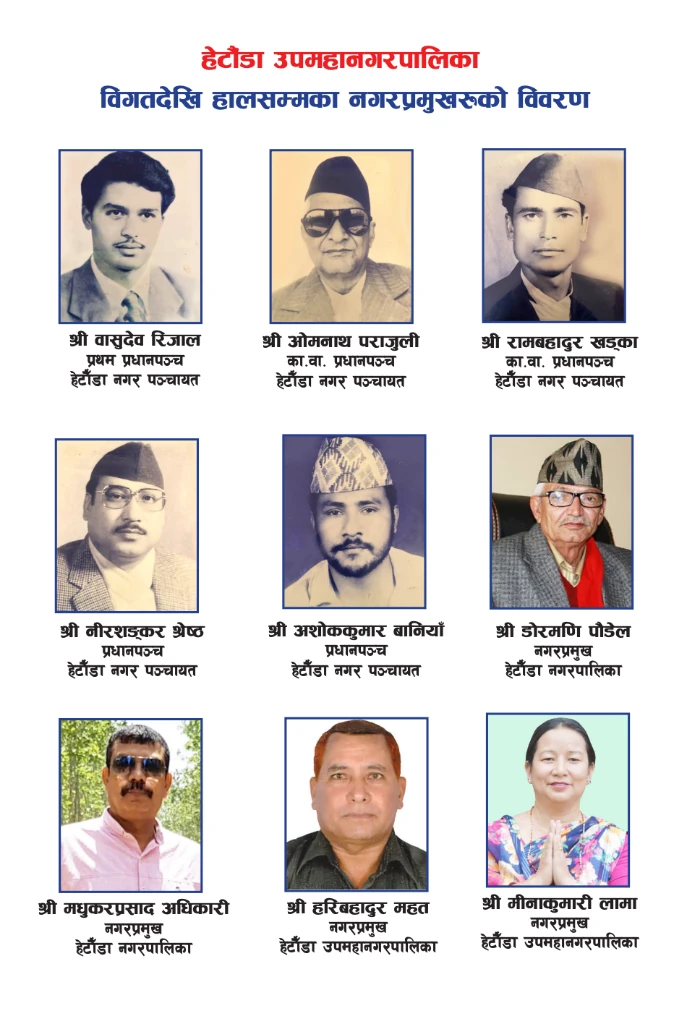
The leadership of Hetauda has evolved across different constitutional eras—from the early Gaun & Nagar Panchayat to the modern Sub-Metropolitan City:
🏛️ Mayors & Pradhan Panchas of Hetauda:
| Era / Administrative System | Official Post / Designation | Leader Name | Key Contributions |
|---|---|---|---|
| Hetauda Nagar Panchayat | First Pradhan Panch | Vasudev Rijal | Enacted 150-Bigha masterplan; paved first roads using returning empty trucks |
| Hetauda Nagar Panchayat | Acting Pradhan Panch | Omnath Parajuli | Interim administrative governance |
| Hetauda Nagar Panchayat | Acting Pradhan Panch | Ram Bahadur Khadka | Interim municipal coordination |
| Hetauda Nagar Panchayat | Pradhan Panch | Neer Shankar Shrestha | Expansion of town roads & commercial bazaar zoning |
| Hetauda Nagar Panchayat | Pradhan Panch | Ashok Kumar Baniya | Institutional strengthening and public market sheds |
| Hetauda Municipality | Mayor | Dorman Poudel | Green city initiatives, compulsory tree planting (later 1st Chief Minister of Bagmati Province) |
| Hetauda Municipality | Mayor | Madhukar Prasad Adhikari | Municipal utility expansion and urban road blacktopping |
| Hetauda Sub-Metropolitan City | Mayor | Hari Bahadur Mahat | Greater Hetauda integration, 19-ward infrastructure & Makwanpur Gold Cup |
| Hetauda Sub-Metropolitan City | Mayor | Mina Kumari Lama | First female mayor; enacted Nepal's first 10,000L free drinking water municipal subsidy |
From pioneering gravel road construction in the 1960s to modern provincial capital governance, each administration has reinforced Hetauda's reputation as a clean, orderly city.
6. Clean City Mandates, Green Bylaws & Citizen Utilities
Hetauda has repeatedly received national awards from the Ministry of Federal Affairs as Nepal's Cleanest and Greenest City, distinguished by unique civic bylaws:
🌿 Progressive Urban & Environmental Policies:
- •Compulsory Tree-Planting Building Bylaws: Under municipal building permit regulations, every new private and commercial building must plant at least two native shade/fruit trees on its premises to receive an official Building Completion Certificate (Nirman Sampanna Pramanpatra).
- •Strict Industrial Zoning: Heavy industrial emissions are quarantined inside the dedicated Hetauda Industrial District in Ward 8, preserving fresh air in downtown residential sectors.
- •10,000-Liter Free Drinking Water Subsidy: Nepal's first municipal policy providing 10,000 liters of monthly drinking water free to all metered households via the Hetauda Drinking Water Management Board.
- •Expansive Green Sanctuaries: Preserved open spaces including Huprachaur Ground in Ward 4, Sahid Smarak Park in Ward 11, and protected Sal forest belts.
Discover historic fortresses, monuments, and parks in our Best Places to Visit in Hetauda Guide or explore local neighborhoods with our Postal Code & Ward Map Guide.
Places Mentioned in this Guide
Hetauda Industrial District (HID) Administration (हेटौँडा औद्योगिक क्षेत्र व्यवस्थापन कार्यालय)
📍 Hetauda Industrial District, Ward No. 8 (Kamane), Hetauda
Hetauda Drinking Water Management Board (हेटौँडा खानेपानी व्यवस्थापन बोर्ड)
📍 Harikunj, Ward No. 2, Hetauda
In this Guide
- 1. Administrative Capital of Bagmati Province & 261.58 km² Land Use
- 2. Census Demographics, Household Data & 50-Year Urban Projections
- 3. The 'Greater Hetauda' Administrative Evolution (1956–Present)
- 4. Participatory Planning Framework & The 3 Transformative Project Tiers
- 5. Historical Leadership Register (Mayors & Pradhan Panchas)
- 6. Clean City Mandates, Green Bylaws & Citizen Utilities